Drainage Solutions in Addison, IL
Standing water, soggy yards, and foundation flooding don't fix themselves. Midwest Breeze Landscaping designs and installs residential drainage systems across DuPage County — French drains, catch basins, grading corrections, downspout routing, and dry wells — engineered to move water away from your home and off your property for good.
Yard Drainage & Water Management
If water pools in your yard after every rain, sits against your foundation, or turns your backyard into a swamp for days at a time — you have a drainage problem. And in DuPage County, it’s one of the most common issues homeowners deal with.
The reason is the soil. Most properties in Addison and the surrounding suburbs sit on heavy clay that drains extremely slowly. When it rains, water has nowhere to go. It collects in low spots, saturates garden beds, floods window wells, and creeps toward your foundation. Over time, this leads to basement moisture, cracked foundations, dead landscaping, mosquito breeding, and erosion that washes away topsoil and mulch.
At Midwest Breeze Landscaping, we solve drainage problems at the source — not with band-aid fixes. We assess how water moves across your property, identify where it’s collecting and why, and install the right combination of grading corrections, French drains, catch basins, downspout extensions, channel drains, and dry wells to redirect it permanently.
Every drainage system we install is designed for DuPage County’s clay soil, stormwater regulations, and the volume of rain this area receives. We don’t guess at pipe sizes or trench depths — we calculate based on your lot’s conditions. The result is a system that handles heavy storms without backing up, freezing, or failing, and that works invisibly beneath your landscape so your yard still looks great.
Engineered for Clay Soil
DuPage County's clay-heavy soil is the root cause of most residential drainage problems. It doesn't absorb water the way sandy or loamy soil does. We design every system to account for slow percolation rates and high runoff volume — the two conditions that make drainage work in this area fundamentally different from other regions.
Solves the Problem Permanently
We don't just dig a trench and hope for the best. Every installation starts with a site assessment to understand how water moves across your property. We address the cause — not the symptom — so you're not calling someone back next year for the same issue.
Code-Compliant Installation
DuPage County has stormwater management regulations that dictate where and how water can be discharged from your property. You can't route your drainage onto a neighbor's lot or into the storm sewer without proper permitting in many cases. We know the local codes and build systems that comply.
How Our Drainage Process Works
Drainage issues are diagnosis problems first and installation problems second. Here's how we approach every project.
Site Assessment & Water Mapping
We walk your property and map how water moves — where it enters, where it collects, and where it needs to go. We check foundation grading, downspout discharge points, low spots in the yard, soil saturation areas, and any existing drainage that may be clogged or undersized. This assessment determines which solution is right for your property.
System Design & Proposal
Based on the assessment, we design a drainage plan that addresses every problem area. You receive a written proposal with the system layout, materials, pipe routing, discharge points, and cost. We explain why each component is needed and how the system works as a whole — no mystery about what you're paying for.
Installation
We excavate trenches to proper depth and slope, install corrugated or solid drain pipe on a gravel bed, set catch basins and grates at collection points, and backfill with drainage stone and filter fabric to prevent sediment clogging. Downspout connections are tied in, grading corrections are made, and all disturbed turf is restored with topsoil and seed or sod.
Testing & Restoration
Before we close everything up, we test the system by running water through it to verify flow rate, slope, and discharge. Once confirmed, we finish the restoration — regrading any disturbed areas, replacing sod, reseeding, and cleaning the site. When we leave, the system is working and your yard looks like we were never there.
Drainage Systems We Install
French Drains
A perforated pipe installed in a gravel-filled trench that intercepts subsurface water and redirects it away from problem areas. French drains are the most effective solution for yards where water saturates the soil and pools across broad areas. We install them along foundations, at the base of slopes, and through low-lying sections of the yard.
Catch Basins & Grate Drains
Surface-level collection points that capture standing water and channel it into an underground pipe system. Catch basins are installed in the lowest points of your yard, at the bottom of slopes, and in areas where water visibly pools after rain. Connected to solid discharge pipe that routes water to the street, a dry well, or another approved outlet.
Downspout Extensions & Underground Routing
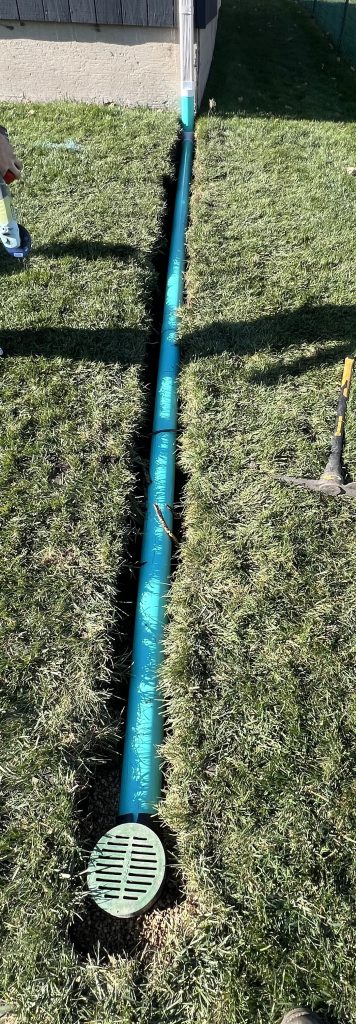
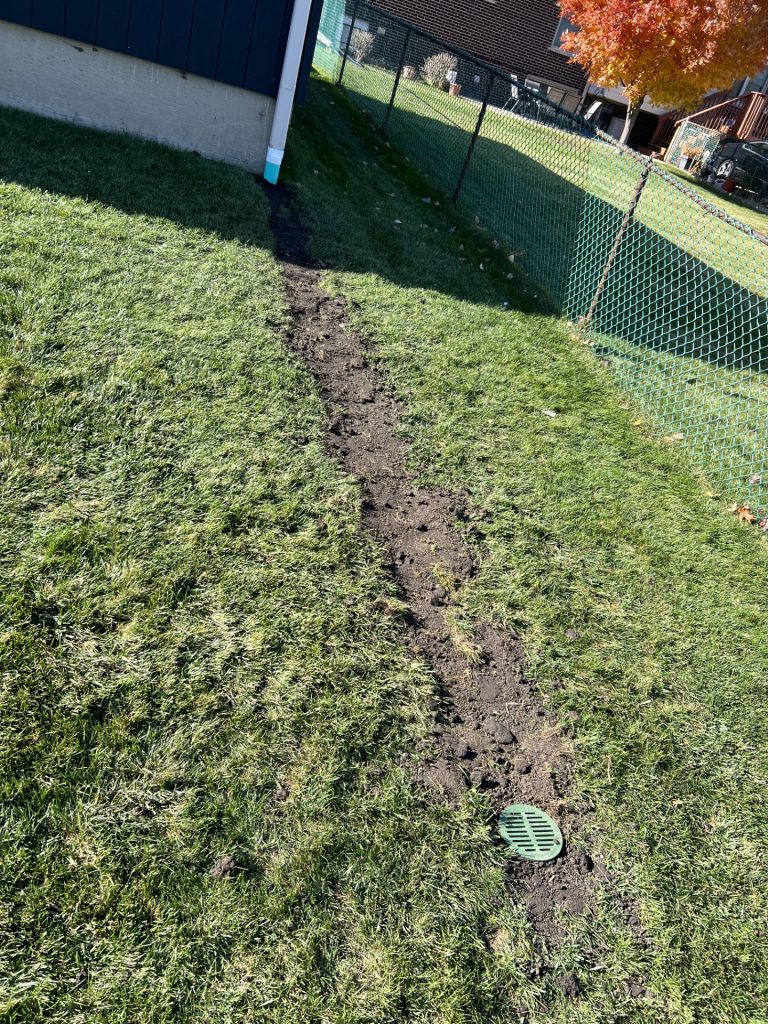
Gutter downspouts that dump water right at your foundation are one of the most common causes of basement moisture and foundation damage. We connect downspouts to underground solid pipe that carries roof runoff 15 to 30 feet away from the house and discharges it at a safe location. This single fix solves foundation drainage issues on the majority of properties we service.
Dry Wells
Underground collection chambers that receive drainage water and allow it to slowly percolate back into the soil. Dry wells are used when there's no good surface discharge point — the water goes underground instead of across the yard. We size dry wells based on the volume of water they need to handle and the percolation rate of your soil.
Grading & Swale Corrections
Sometimes the problem is simpler than it looks — the ground is sloped toward the house instead of away from it. We regrade soil around foundations, create shallow swales to direct surface water, and correct low spots that trap water. Grading corrections are often combined with drain systems for a complete solution.
Channel Drains
Linear drains installed across driveways, patio edges, and garage aprons where water sheet-flows toward structures. Channel drains intercept water at the surface and route it into the drainage system before it reaches your garage, basement, or walkway. Essential for properties where the driveway slopes toward the house.
Recent Drainage Projects in Addison & DuPage County
Service Area
Midwest Breeze Landscaping installs residential drainage systems throughout Addison and the surrounding DuPage County suburbs. Drainage problems are widespread across this area because of the soil composition and development patterns — most neighborhoods were built on clay-heavy ground that holds water instead of absorbing it.
Properties near Salt Creek and the DuPage County Forest Preserve tend to see the worst drainage issues due to higher water tables and floodplain proximity. Older neighborhoods in Elmhurst and Villa Park often have outdated clay tile drainage that has cracked or collapsed over time. Newer subdivisions in Carol Stream and Glendale Heights frequently have grading issues from the original construction — builder’s fill compacts unevenly and creates low spots that weren’t there when the house was new.
DuPage County also has stormwater management regulations administered by the county’s Stormwater Management division. Depending on your municipality, there may be requirements around where drainage water can be discharged and whether a permit is needed. We’re familiar with these local regulations and ensure every system we install is compliant.
Drainage Solutions FAQ
Residential drainage projects in DuPage County typically range from $1,500 to $8,000 depending on the scope. A simple downspout rerouting with underground pipe runs $1,500 to $2,500. A French drain along one side of a foundation is usually $2,500 to $4,500. A full property drainage system with multiple catch basins, French drains, and grading corrections can run $5,000 to $8,000 or more. We provide free on-site assessments and detailed written proposals so you know the full cost upfront.
In most cases, it's a combination of clay soil and improper grading. DuPage County's clay-based soil absorbs water very slowly, so after even a moderate rain, water sits on the surface instead of draining down. If your yard is flat or graded toward the house instead of away from it, water has nowhere to go. Add in downspouts that dump water right at the foundation, and you've got standing water, soggy turf, and potential basement issues. A properly designed drainage system gives that water a path off your property.
A French drain is a subsurface system — a perforated pipe in a gravel-filled trench that collects water as it seeps through the soil. It's best for areas where water saturates the ground over a wide area. A catch basin is a surface collection point — a grate or box that captures standing water from the top and feeds it into an underground pipe. Catch basins work best in specific low spots where water visibly pools. Most properties benefit from a combination of both, depending on where and how water is collecting.
In many cases, yes. We use narrow trenching methods and minimize the footprint of the installation as much as possible. All disturbed areas are restored with topsoil and seed or sod after installation. For some problems — like regrading around a foundation or rerouting downspouts underground — the disruption is relatively minor. For larger systems involving multiple runs of pipe across the property, there will be more excavation, but we restore everything to its original condition before we leave.
It depends on the scope and discharge point. Simple residential drainage systems that discharge within your own property — like a French drain routed to a dry well — typically don't require a permit in the Village of Addison. Systems that tie into the municipal storm sewer or discharge at the street may require approval. DuPage County's Stormwater Management division also has regulations for larger projects. We research the requirements for your specific project and handle any necessary permitting.
Yes, but it has to be designed for clay conditions. In sandy soil, water drains quickly into a French drain from all directions. In clay, water moves much slower, so the drain needs to be sized, sloped, and positioned correctly to intercept water before it saturates the surrounding soil. We wrap the pipe and gravel bed in filter fabric to prevent clay sediment from clogging the system, and we use a clean stone that promotes flow. Properly installed, French drains work extremely well in DuPage County clay — they just require more careful engineering than in lighter soils.
Ready for Professional Drainage Solutions?
Contact us today for a free estimate. Serving Addison, IL and the surrounding Chicagoland area.